The kind of lonely men don't talk about.
1 in 7 American men has no close friends, up from 1 in 33 in 1990. A psychologist-informed guide to what's actually happening, and what helps. Read the full piece →
Psychological AI
Built by Psychologists


Emily, Marcus, Liam & Sarah are psychological AIs. Their portraits are AI-generated.

Your data is yours. We never sell it. It stays on servers in the EU under the GDPR, encrypted in transit and at rest.
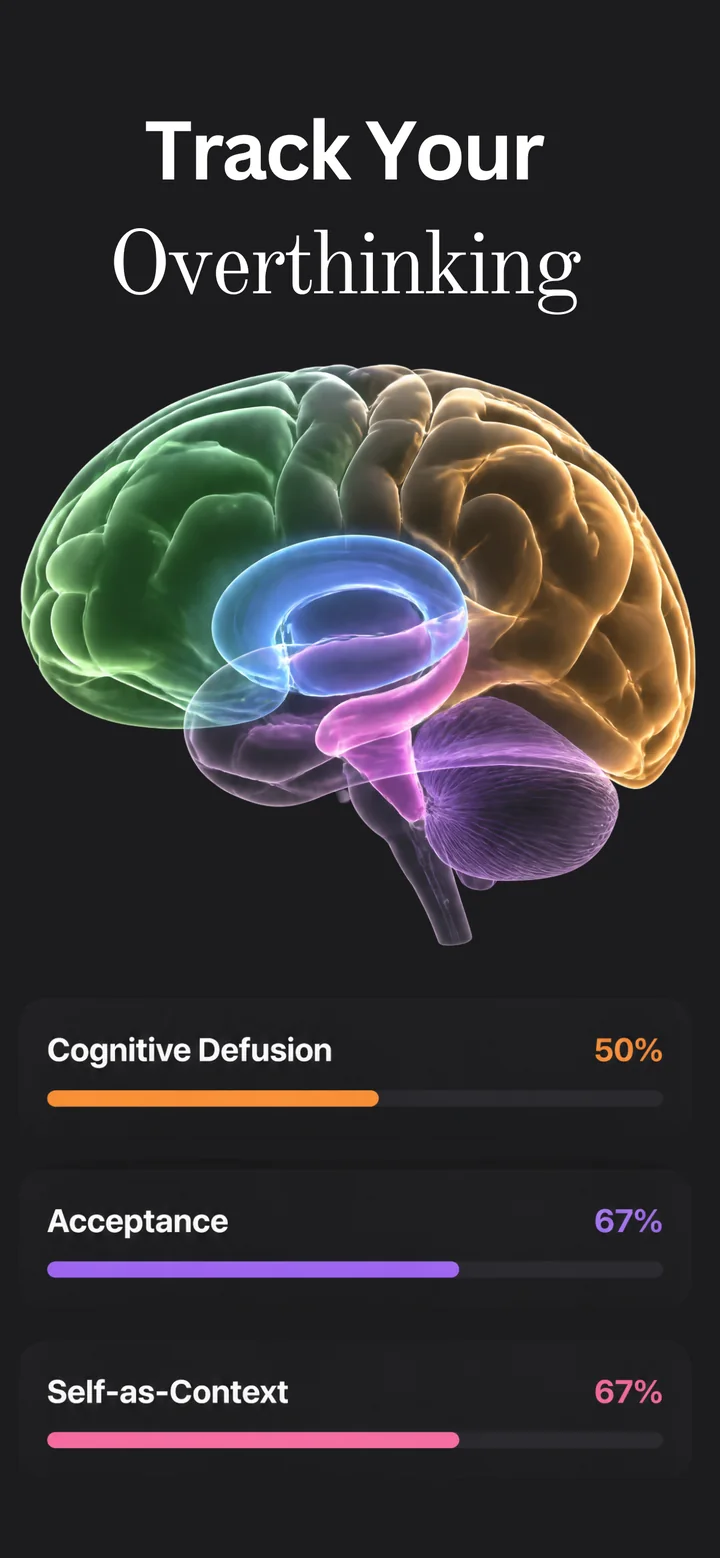


You turn every detail over in your head, you second-guess every decision, and you play out every possible outcome of a situation that may never even happen.
You can never really switch off. You often lie awake late into the night, full of questions you ask yourself and cannot answer. Over time you get worn down, tired and exhausted. Your mind never truly gets the time to recover and gather new strength.
Almost nobody understands it. Lines like “don’t think about it so much” or “it will all work out” are not just useless, they wind your thoughts up even more. And “why don’t you talk to your friends” may have been good advice ten years ago.
But there might be something that helps you after all. Before I get to that, I need to explain one thing.
Whether a thought carries you away or you simply notice it comes down to a single ability: mental flexibility. It is not a character trait you either have or you don’t, it is a skill that can be measured and trained. That is why research has been studying it for decades.
When you overthink, that is exactly the ability that is missing. You get stuck in an emotionally loaded thought and you cannot get out of it. It even pulls you deeper into the drama, and it keeps getting worse.
Put simply: the more flexibly you handle your own thoughts, the less power a single thought has over you. You do not have to get rid of the thought. You only have to stop working on it. And that is something you can practise.
This is exactly where Mindflex comes in. Mindflex is a psychological AI for Overthinkers built by psychologists. Btw here’s how we protect you, your data, and your wellbeing.
A common objection to AI is that it can give bad advice or handle what you tell it carelessly. The objection is fair, it just applies to people in exactly the same way. Mindflex is not meant to replace your friends’ advice. But the human support you are pointed to is simply not there for a lot of people.
Once a week you can have a call, at a time you pick yourself and get training on the six skills of mental flexibility: acceptance, cognitive defusion, contact with the present moment, self-as-context, values, and committed action, at your own pace. And each month you can measure your progress and track your overthinking.
Also, Mindflex works especially well together with an Apple Watch. When your watch notices stress signals, your psychological AI can reach out, check in on you and assist you in stopping overthinking before it begins.
Tap the download button now and get Mindflex from the App Store.
FROM OUR WRITING
★★★★★
Get a 7 day free trial if you download the app now.

Mindflex · psychological AI, built by psychologists & psychotherapists
Science backed psychological AI, built in Berlin by psychologists and psychotherapists. Weekly sessions train your mental flexibility, with a companion you can call or text whenever you need.
7 days free. On iOS and Android.
Mindflex is a reflection companion developed by clinical psychologists in Berlin. It is a space for self-reflection and emotional wellbeing, for the moments that do not belong to therapy, do not fit into a call with a friend, and do not make it into your day. Four AI companion personas hold conversation in distinct styles: Sarah (warm and empathetic), Marcus (direct and grounded), Liam (practical and action-oriented), Emily (reflective and creative). You choose whoever feels right. All four are psychological AIs and their portraits are AI-generated. Mindflex is not therapy, not a medical device, and not a substitute for professional care. If you are in crisis, please contact 988 in the US, 112 in the EU, or Telefonseelsorge 0800 111 0 111 in Germany. Available as an app on iOS and Android. Free to try for 7 days; subscription pricing is shown in the app.
We are clinical psychologists who saw what happens between sessions: the 2am thoughts, the questions with no one to ask. We built Mindflex because the most powerful thing in psychology isn't a method. It's being heard. And that shouldn't be limited to one hour a week.
We are building a world where no one has to carry their thoughts alone.
No. Mindflex is an AI companion for reflection and conversation, not a human therapist. It helps you sort your thoughts, feel heard, and find clarity. For clinical care, we always recommend working with a licensed professional.
No. Mindflex is a reflection companion, not a human therapist. It does not treat, diagnose, or track disorders. If you need more support than Mindflex can provide, please reach out to a professional.
Completely. Your conversations are stored under a random ID, not your name or email. We never sell your data or share it with third parties. You can delete everything at any time.
Mindflex is not designed for crisis situations. If you are in immediate danger: in the US, call or text 988. In the EU, call 112. In Germany: Telefonseelsorge 0800 111 0 111 (free, 24/7).
Free to start with a 7-day trial, no credit card needed up front. Mindflex Pro starts at $5 per week, with monthly ($15) and yearly ($90) options, and unlocks unlimited conversations with all four companions, voice calls, and biographical memory. About the price of one coffee, built by psychologists rather than meditation coaches.
Unlike meditation apps that guide you through exercises, Mindflex is a conversational AI companion. You talk, it listens and responds, more like a thoughtful conversation about what's on your mind. Designed by psychologists for reflection, not guided meditations.
"Mindflex helped me after just two days. Before an important call, I opened the app and talked it through. It genuinely made a difference."L., 28
"I didn't think an AI could make me feel this heard."J., 31
"I'm 53, I've been through a lot. Mindflex gave me something I didn't expect: a space where I actually feel understood."K., 53
Long-form pieces on the quiet mental-wellness topics our clinical team thinks are worth reading carefully. Reviewed before publication. Updated when the evidence changes.
1 in 7 American men has no close friends, up from 1 in 33 in 1990. A psychologist-informed guide to what's actually happening, and what helps. Read the full piece →
Perimenopause doubles the odds of depressive symptoms in many women, and almost no one mentions it. A psychologist-informed guide to what is happening, and what helps. Read the full piece →
53 million Americans are unpaid caregivers. About 40 percent meet criteria for clinical-level burnout. A psychologist-informed guide to what actually helps. Read the full piece →
Real pathways, realistic timelines, real costs. How to actually find a therapist in the U.S. when every option feels closed. Read the full piece →
Why the mind won't stop, what the research actually shows, and seven concrete things that help. Written by clinical psychologists. Read the full piece →
 Mindflex🇬🇧EN▾
Already have an account? Sign in
Mindflex